STUDY NOTES / TWO PARTS
What Have Studies Found About CJC-1295 Ipamorelin?
Twenty-two papers cover humans and animals. Each number leads back to its study.

What CJC-1295 Ipamorelin Changes in the Body
CJC-1295 tells the growth gland to make more hormone. Ipamorelin helps that gland release short bursts [13].
The growth gland sits at the base of the brain. Growth hormone helps guide growth, bone, muscle, and body fat.
CJC-1295 and ipamorelin reach the gland in different ways. Studies have not proved a health gain from the pair.
In one human study, healthy men got a CJC-1295 shot. The dose was 60–90 micrograms based on each kilogram the men weighed.
One week later, average growth hormone was up 46%. IGF-1, a growth-linked blood protein, was up 45% [1].
The gland still sent growth hormone out in bursts. The low point between bursts also rose.
Researchers tested ipamorelin in rats and pigs. It didn't raise six other hormones they checked [3].
Even above two hundred times the main amount, those hormones didn't rise. The paper compared older test drugs called GHRP-6 and GHRP-2.
That is an animal finding, not a human one. The papers covered six kinds of animals.
They were rats, mice, pigs, cows, dogs, and horses. A horse-racing test found 50 trillionths of a gram in a milliliter of blood [22].
That shows the test's reach, not a safe amount. Other papers asked how long CJC-1295 stays in blood [2].
Rat studies measured bone length and bone mineral [4][9]. Another rat study watched the gut after surgery [10].
A small human study looked at deep sleep [12]. Mice born without one growth message grew to normal size [5].
Healthy men also had changes in IGF-1 and other blood proteins [6]. Neither drug has FDA approval for people.
Both drugs are banned in tested sport. This site checked 22 findings in published papers.
Each number points to its paper in References. Keep the human and animal work apart.
Their combined count can't predict your result.
What the CJC-1295 Ipamorelin Blend Does Together
The CJC-1295 ipamorelin blend joins two body messages. One raises the base, while the other brings short bursts.
CJC-1295 tells the growth gland to make more hormone. Ipamorelin helps the gland release that hormone.
A study tested both messages in people and four animal types. Together, they made more hormone than expected [13].
The bursts didn't flatten during a steady test feed. Growth hormone still rose and fell in waves.
The body's brake also stayed in place. IGF-1, a growth-linked blood protein, could still slow the gland.
A growth hormone shot skips that gland. These two drugs ask the gland to do the work.
Read what each drug does for the plain steps. That section also marks what hasn't been tested.
The CJC-1295 ipamorelin dosage page lists study amounts. It isn't a guide for personal use.
The CJC-1295 ipamorelin benefits page covers bone, sleep, and weight. It separates people from animals.
Treat the CJC-1295 and ipamorelin messages as a study finding. Your health result wasn't measured in that work.
What CJC-1295 Ipamorelin Did in Studies
What did the studies find? Most direct results came from rats, not people.
One rat study found faster bone growth. The rate rose from 42 to 52 micrometers a day over 15 days [4].
Another study tested bone loss caused by steroids. New bone formed at a 4-fold higher rate [8].
A third rat study measured bone mineral. The bones grew wider but not more dense [9].
Rats also had gut trouble after surgery. Ipamorelin helped food and waste move again [10].
Human findings are much narrower. CJC-1295 raised growth hormone and IGF-1, a growth-linked blood protein [1].
The men's IGF-1 and other blood proteins changed [6]. The paper didn't show that they felt better.
One sleep study gave ghrelin to seven people [12]. They got more deep sleep but didn't receive ipamorelin.
What does that mean for you? No study proves the pair treats a health problem.
Neither drug has an FDA-approved use. Animal findings can't fill that gap.
Check the animal named in each result. Its result isn't your result.
What Keeps CJC-1295 in Blood Longer
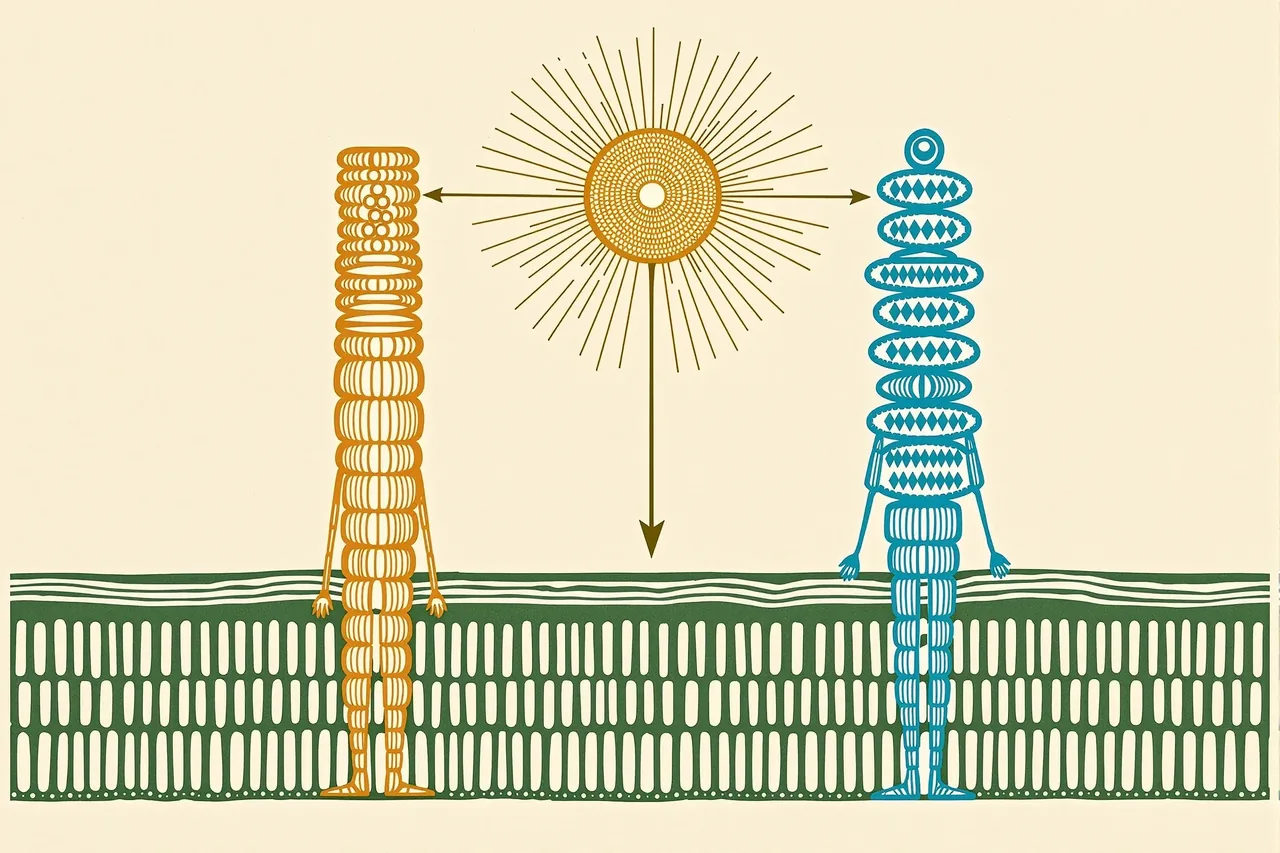
CJC-1295 is a lab-made copy of a body message. That message tells the growth gland to release hormone.
One form has a part that fastens to albumin. Albumin is a common protein in blood.
The paper calls the attachment point spot 34. That spot offers no clue about safety.
The hold keeps CJC-1295 in blood longer. Its stay rose from under 13 minutes to 6–8 days [2][16].
The form without that part leaves sooner. It acts more like the body's short message.
Ipamorelin is a peptide, meaning a short protein chain. A listed lab weight doesn't show whether it works.
The useful finding is the growth hormone burst. That finding came mainly from animal work.
In rats, ipamorelin cleared 5-fold more slowly than an older test drug called GHRP-6. The rats passed 60–80% into bile and urine without breaking it down.
After a nose dose, about 20% reached the rats' blood [7]. That compares the amount given with the amount found in blood.
The rat result doesn't show a safe amount. It also hasn't been shown in people.
No sound paper gives its blood time in people. Your body's response remains unknown.
What CJC-1295 Does to the Growth Gland
CJC-1295 copies a message made in the brain. That message tells the growth gland to make growth hormone.
The body's own message breaks down fast. The lab-made drug has four changed protein parts that slow the break.
One form also holds onto albumin in blood. That helps it stay active for 6–8 days [16].
The form without that hold leaves much sooner. Its effect is closer to the body's short message.
Tesamorelin is a related drug. It isn't the same as CJC-1295.
In 2010, FDA approved tesamorelin for one HIV-associated fat problem. A human study found less deep belly fat over 26 weeks [18].
That result shows the drug family can affect body fat. It doesn't prove the other drug does the same.
Tesamorelin was tested in people with HIV. Keep that group in mind when comparing claims.
Watch which drug and people were tested. Your answer can't come from a related drug.
What Peptides Do in the Body
Peptides are short chains made from protein parts. This group usually has fewer than 50 parts.
Each peptide can carry a message to certain cells. Ipamorelin has five parts and carries one growth message.
CJC-1295 is a 29-residue chain, meaning a chain of protein parts. Lab changes help it remain in blood longer.
Growth hormone weighs about 22,000 daltons in lab terms. The drug weighs about 3,367 daltons.
A dalton is a tiny weight unit for molecules. These weights don't show whether either drug works.
Researchers use peptides to study one body message. They watch blood, bone, sleep, or the gut.
A finding belongs to the group that was tested. Rat bone work doesn't become your bone result.
For more background, see how these drugs prompt the gland. That page marks findings from people.
You don't need molecule weights to follow the work. Your useful question is who was tested.
What Happens When the Two Peptides Are Paired
CJC-1295 raises the low point between growth hormone bursts. Ipamorelin helps bring on a fresh burst.
In 2005, researchers tested those messages together [13]. They studied people, rats, pigs, cows, and dogs.
Ipamorelin also eased the body's brake on growth hormone. That let the brain send more of its own message.
Together, the messages made more hormone than expected. The finding appeared in all five groups tested.
A steady test feed didn't erase the body's bursts. Growth hormone still rose and fell in waves.
A growth hormone shot works another way. The shot puts hormone in without asking the gland.
This was body research, not proof of better health. The work didn't measure your kind of outcome.
The missing health test matters most. It keeps any personal claim unproved.
What the Rules Do Not Allow
FDA has approved neither CJC-1295 nor ipamorelin for people. One long-lasting CJC-1295 form reached early human studies.
Ipamorelin reached early work for bowel slowdown after surgery. No main paper tells what happened in that study.
Neither drug finished the large human tests usually needed for approval. Early work doesn't change that fact.
Both drugs are banned in tested sport. That rule matters to any athlete who may be tested.
FDA records CJC-1295 as a bulk substance with a withdrawn nomination. That withdrawal gives no permission to compound it; ipamorelin acetate remains in Category 2 for 503B compounding on FDA's safety list.
You can read the full CJC-1295 rule summary. It sets known facts apart from open questions.
Use that page to check the legal facts. Your doctor handles health questions.